Agency pricing · 2026
How much do marketing agencies charge hotels? The 4 pricing models, ranked by risk.
Most agencies will not publish a price. Here are the real 2026 ranges, the four ways you can be billed, and the seven red flags that turn a “results only” deal into a bill for guests you already had.
By Giuseppe Gaspari, founder. Updated September 2026. Price ranges cite 2026 agency and industry sources.
Fifteen-plus years running paid search, SEO, and conversion tracking for tourism and lodging operators. Full bio
The short answer
- Hotel agencies charge $3,000 to $25,000 a month. Independent properties usually land at $4,000 to $12,000, plus ad spend.
- A retainer puts all the risk on you. The fee is due in a dead month the same as a sold-out one.
- Performance pricing moves the risk, but only if the counting rule excludes repeat guests and branded search.
- The fairest version bills new guests only, booked direct, measured on your own booking engine.
Pricing models
The 4 ways agencies charge hotels, ranked from most risk to you to least.
The monthly retainer
- What you pay:
- A fixed fee every month, typically $3,000 to $12,000 for an independent property.
- Who carries the risk:
- All on you. The fee is due whether the phone rings or not.
- The catch:
- Ad spend is usually billed on top, so the real monthly number is higher than the quote.
Retainer plus a cut of ad spend
- What you pay:
- A smaller base fee plus a management fee on media, with PPC minimums of $1,000 to $5,000 a month common.
- Who carries the risk:
- Mostly on you, and it grows as the agency spends more of your money.
- The catch:
- The agency earns more when spend goes up, not when bookings go up. Those are different goals.
Revenue share on all bookings
- What you pay:
- A percentage of every attributed booking, including guests who already knew you.
- Who carries the risk:
- Shared, on paper.
- The catch:
- Repeat guests and branded searches get billed as wins. You pay commission on bookings you would have had anyway.
Pay per new-guest booking
- What you pay:
- A percentage of each booking from a guest who has never stayed with you, booked direct, and actually stayed.
- Who carries the risk:
- On the agency. No new guests, no bill.
- The catch:
- It only works if the counting rule is written down and measured on your booking engine, not the agency's dashboard.
| Model | What you pay | Who carries the risk | What you are billed on |
|---|---|---|---|
| Monthly retainer | Fixed fee + ad spend | You | Hours and deliverables |
| Retainer + % of spend | Base + media fee + ad spend | Mostly you | How much is spent |
| Revenue share (all bookings) | % of attributed bookings | Shared | All attributed bookings, repeat guests included |
| Pay per new-guest booking | % of new-guest direct stays | The agency | New guests only, on your booking engine |
What it costs
How much hotel marketing costs in 2026: 6 real price ranges.
- 1Hotel marketing agency, full serviceZanobe, 2026$3,000 to $25,000 / month
- 2Independent hotel engagementFormula Marketing, 2026$4,000 to $12,000 / month, plus media
- 3General marketing agency retainerWebFX, 2026$1,000 to $12,000 / month
- 4PPC management minimumSwydo, 2026$1,000 to $5,000 / month, plus $500 to $3,500 setup
- 5Hotel PR, independent boutiqueEverything-PR, 2026$3,000 to $8,000 / month
- 6Full in-house marketing teamSwydo, 2026$300,000 to $500,000+ / year
One more number belongs on this list, even though no agency sends you the invoice: OTA commission. At 15 to 25% of every booking, it is often one of the biggest marketing costs an independent property pays. See the 2026 OTA commission rates for the platform-by-platform breakdown.
The honest answer
Is it worth it to hire a marketing agency? 5 signs yes, 3 signs no.
Worth it if…
- You have empty rooms outside peak season and no plan to fill them. (Start with the low-season playbook.)
- More than a third of your bookings come through OTAs.
- You run a real booking engine (Cloudbeds or similar) that can take direct bookings.
- Nobody on your team has the time to run ads, SEO, and email properly.
- The agency will tell you, in writing, exactly what it counts as a result.
Not worth it if…
- You are already full most of the year at the rate you want.
- Your website cannot take a booking without a phone call.
- The only pricing on the table is a fixed retainer with no way to measure bookings.
Read the fine print
7 red flags in a “results only” marketing deal.
Performance pricing sounds like the answer to retainer risk, and it can be. The catch is attribution: who decides which bookings the agency caused. Watch for these.
- 1
They bill on repeat guests.
If a guest who stayed last summer books again, that is your brand working, not their campaign.
- 2
Your own brand name counts as their win.
Someone who types your resort's name into Google already chose you. Ask how branded searches are treated before you sign.
- 3
Their dashboard is the scoreboard.
Ad platforms over-count and cannot tell a new guest from a returning one. Your booking engine should settle every invoice.
- 4
Long or vague attribution windows.
The longer the window after a click or a view, the more bookings they can claim. Ask for the exact window in writing.
- 5
View-through credit.
Billing you because a guest scrolled past an ad they never clicked is how bookings you already had get invoiced.
- 6
No clawback on cancellations.
If a guest cancels or no-shows, that booking should come off your bill automatically.
- 7
Ad spend billed on top, uncapped.
"Results only" with an open-ended media bill is a retainer with extra steps.
The standard we publish
The 4-rule test for a fair pay-per-booking deal.
This is the exact rule The No Vacancy Co. bills on. A booking counts only when all four are true:
- 1. New guest. Their email is not already in your booking history. Repeat guests are never billed.
- 2. Direct. It came through your booking engine, not an OTA. The guest and their data stay yours.
- 3. Attributable. It ties to a channel we run, by a click window or a tracked code named in the agreement.
- 4. Materialized. The guest actually stayed. Cancellations and no-shows come off the next invoice.
Your booking engine’s new-guest export is the ledger. If it ever disagrees with an ad platform, the booking engine wins. We fund the ads, and the monthly bill is capped against that month’s ad spend.
Isn’t this what Google’s commission ads did?
Close, but no. Google Hotel Ads used to offer commission-per-stay bidding, and Google retired it in February 2025. Most pay-per-stay programs bill on attribution alone, without a documented rule for repeat guests. The difference that matters is the counting rule: new guests only, measured on your ledger.
Worked example
Same year, two bills: a retainer vs pay-per-new-guest.
Take an independent lodge with a $650 average booking, weighing two offers. Offer A is a $4,000 monthly retainer plus $1,500 a month in ad spend. Offer B is pay-per-new-guest with the agency funding the ads, priced meaningfully below an OTA’s cut on the same booking and set on a call once the ADR and booking mix are known. Here is what each costs in a strong year and a weak one.
| Strong year | Weak year | |
|---|---|---|
| New-guest direct bookings | 120 | 25 |
| Booking revenue (avg $650) | $78,000 | $16,250 |
| A: Retainer + ad spend | $66,000 | $66,000 |
| Same bookings through an OTA at 18% | $14,040 | $2,925 |
| B: Pay per new guest, ads funded | $5,600 to $9,700 | $1,100 to $1,900 |
The retainer costs the same $66,000 whether the year brings 120 new guests or 25. In the weak year it costs four times the revenue it produced. The performance bill follows the bookings, and every booking on it is a guest who booked direct and is yours to keep. Numbers are illustrative. Plug your own into the OTA savings calculator.
Before you sign
9 questions to ask any hotel marketing agency.
- What exactly am I billed on, and can I see it written down?
- Do repeat guests or branded searches ever count toward your fee?
- Whose data settles a dispute: your ad platform or my booking engine?
- What is the attribution window, in days, after a click?
- Who pays for the ads, and is there a monthly cap?
- What happens to my bill when a guest cancels or no-shows?
- Do I own the ad accounts, the guest data, and the email list?
- How long is the contract, and is there a trial with no lock-in?
- Can you show me one property's real numbers, including the bad months?
An agency that answers all nine in writing is one you can measure. One that dodges question 3 is asking you to trust its dashboard over your own books.
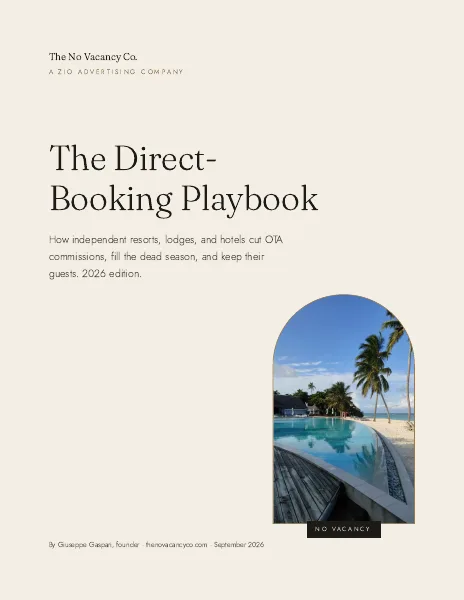
Free 16-page PDF
The Direct-Booking Playbook
OTA math, 11 dead-season moves, the agency red flags, a 90-day plan, and two worksheets in one download.
Common questions
Agency pricing, answered.
- How much does a marketing agency typically cost?
- Most marketing agencies charge a monthly retainer of $1,000 to $12,000, with small businesses at the lower end and full-service, multi-channel work running $15,000 a month or more. Hotel-specific agencies quote $3,000 to $25,000 a month. Ad spend is usually billed on top of the fee.
- How much do hotels pay for marketing?
- An independent property working with a specialist agency typically pays $4,000 to $12,000 a month plus media. The bigger number is often hidden: OTA commissions of 15 to 25% on every booking the platforms deliver, which is often one of the largest marketing costs an independent property pays.
- Is it worth it to hire a marketing agency?
- It is worth it when you have rooms to fill, a real booking engine, and no one in-house who can run ads, SEO, and email well. It is rarely worth it on a fixed retainer if the agency cannot show how it counts results. Pay-per-booking models move that risk off the property.
- Do marketing agencies make you pay for ad spend on top of the retainer?
- Usually, yes. Most retainers cover the agency's time, and ad spend is billed separately, often with a management fee as a percentage of spend. Always ask for the total monthly cost, fee plus media, before you sign.
- How do performance agencies decide which bookings they get paid for?
- Through an attribution rule: which bookings count, over what window, measured by whose data. A fair rule counts only new guests who booked direct and actually stayed, excludes repeat guests, and uses your booking engine as the ledger, not the agency's ad dashboard.
- What happens to my bill if a booked guest cancels or no-shows?
- In a fair pay-per-booking deal, cancellations, no-shows, and refunds are clawed back off the next invoice. You should only ever pay on stays that actually happened.
- Is pay-per-booking marketing cheaper than OTA commission?
- It should be. OTAs take 15 to 25% and keep the guest relationship. A pay-per-new-guest model should cost meaningfully less per booking, and the guest books direct, so their email and their next stay belong to you.
- Can I try performance-based marketing without a long-term contract?
- With some agencies, yes. The No Vacancy Co. starts every property on a 60 to 90 day paid trial with no lock-in, which converts to an annual term only if it is working.
Skip the retainer. Pay only for new guests.
We fund the ads and get paid only on new-guest direct bookings, measured on your booking engine. Always less than an OTA takes. A short call tells you if it is a fit.
Book a private call